

A health practice consultant helps identify what is limiting the business and what needs to change. A business coach helps the owner and team develop the skills, habits and accountability to carry that change through. When a practice faces both a structural problem and an execution gap, it needs both functions working together. Freedom Practice Coaching combines business diagnosis with coaching for the owner and team.
This is a practical distinction between functions, and job titles do not tell you the whole story. Some consultants stay through implementation. Some coaches provide detailed business analysis. What matters is whether the support you buy covers the problem you have, including what happens after the recommendation.
The difference between practice consulting and coaching
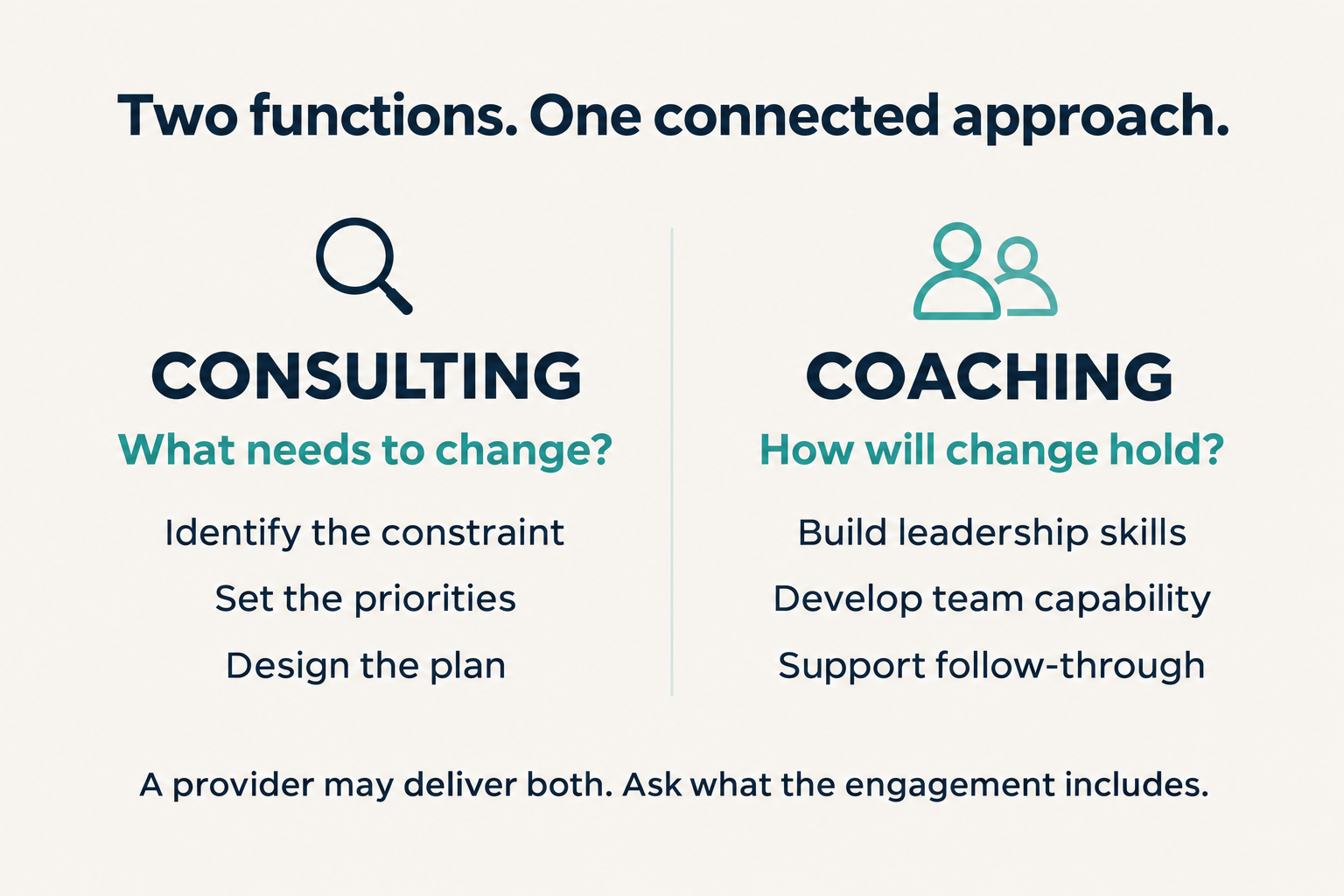
Consulting answers what needs to change and why. Coaching answers how the owner and team will make that change hold. These are complementary functions, and a provider may deliver both.
| Function | Consulting focus | Coaching focus |
|---|---|---|
| Diagnosis | Identify the constraint in the business model, finances or operations. | Help the owner recognize habits and leadership patterns affecting execution. |
| Change | Recommend priorities, a revised model or an implementation plan. | Develop the capability and accountability to put the plan into practice. |
| Follow-through | Scope varies; an advisory engagement may end with recommendations. | Support learning, decisions and behavior as the team implements change. |
When a health practice needs a consultant
Consulting is useful when you need to establish what is actually limiting the practice. A full schedule and disappointing take-home pay can have several causes. Pricing may no longer cover the cost of delivery. Staffing may have grown faster than revenue. The owner may still carry work that prevents anyone else from taking responsibility.
Each explanation calls for a different response. More patient inquiries will not fix a service that costs too much to deliver. A new practice manager will struggle if nobody has defined what that person can decide.
The consulting work is to examine those possibilities, identify the constraint and put the changes in a workable order. A focused consulting engagement may be enough when the problem is well defined and the practice already has the leadership and capacity to implement the recommendation.
When a health practice needs a coach
Coaching is useful when knowing what to do has stopped translating into action. The owner agrees to delegate, then reverses the manager's decisions. The team understands the new process, then abandons it during a busy week. A pricing change is approved but never introduced because the owner keeps postponing the conversation.
These are execution problems. Another explanation of the strategy may not resolve them. The owner needs to practice different decisions, recognize where old habits return and give the team room to become capable.
For a practitioner, that can mean learning to set an operating standard without personally handling every exception. It can also mean unlearning the assumption that doing the work yourself is always the most responsible response. Coaching helps turn an agreed plan into behavior the practice can sustain.
Why diagnosis and execution need to stay connected
A diagnosis without implementation support can leave the owner with a sound plan and no capacity to carry it out. Coaching without a sound diagnosis can help a team execute consistently against the wrong priority.
Consider a practice preparing to open a second location. If the first site has weak margins and depends on the owner for daily decisions, a plan focused only on opening the new site carries those constraints into a second building. The business needs its economics and operating structure examined before the team commits to expansion.
The connection also matters after work begins. If a team struggles to implement a recommendation, the cause may be a training gap, limited authority or a plan that needs adjusting. Someone needs to examine all three possibilities.
Treating every missed milestone as an accountability problem can conceal a design problem.
Separate providers can do this well when they share the diagnosis, priorities and measures of progress. Without that coordination, the owner becomes responsible for translating between advisers while still running the practice. Integration means the people supporting execution can revisit the assumptions behind the plan.
What both functions looked like in one FPC practice
A women's health nurse practitioner came to FPC generating about $58,000 a month in collections. Insurance reimbursements, administrative overhead and a schedule built around short visits left little margin for the care she wanted to deliver.
The business problem was clear. The practice needed a different revenue model. Implementing it required more than a pricing recommendation, though. She worried about what patients would think, how colleagues would respond and whether she was ready to change the practice she had spent years building.
FPC helped her introduce cash-pay programs alongside the existing insurance business, protecting the revenue base while she developed confidence in the new approach. The work connected the financial transition with the personal changes required to carry it through.
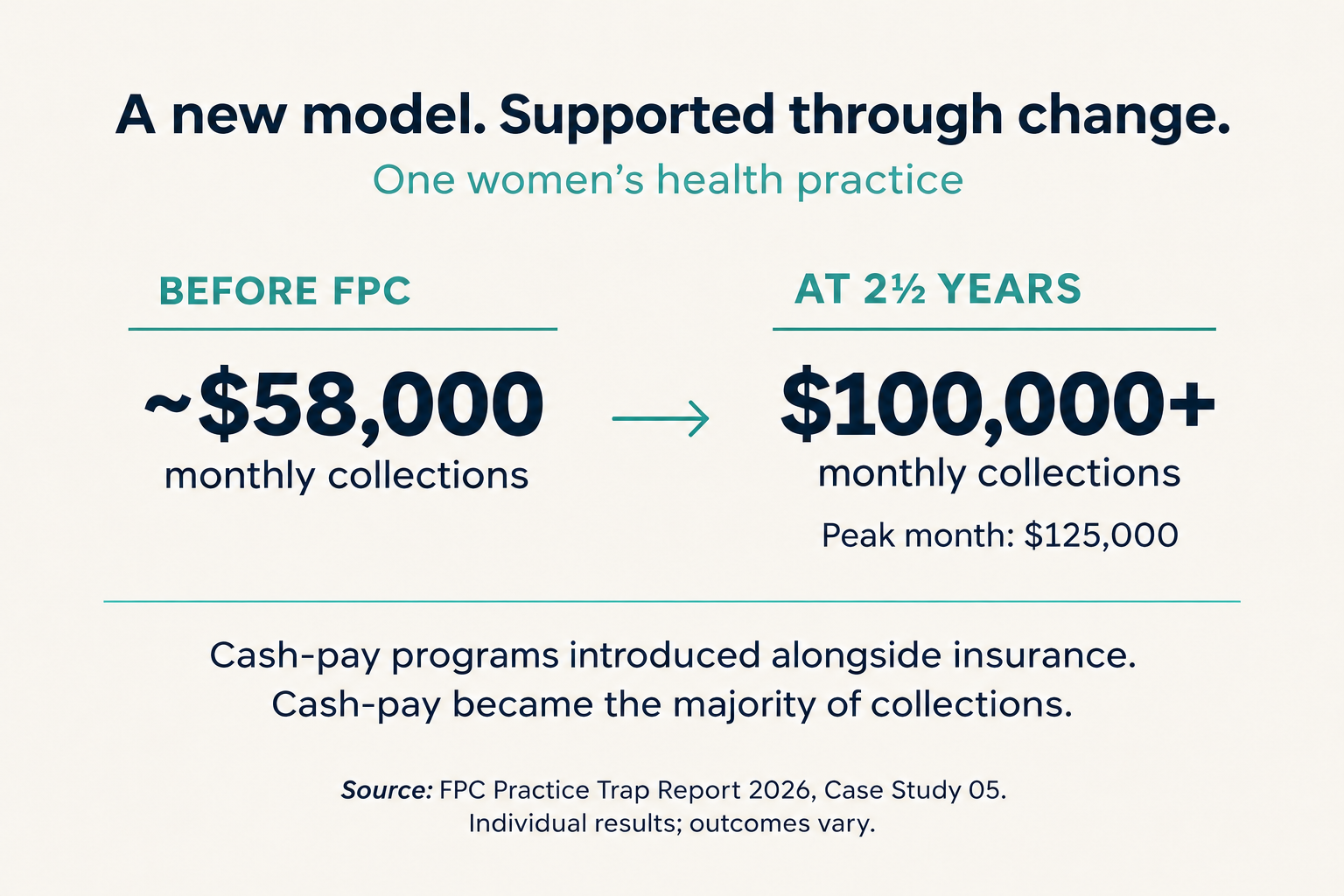
At the case study's two-and-a-half-year mark, monthly collections had risen to more than $100,000, with a peak month of $125,000. Cash-pay programs accounted for the majority of collections. A full insurance exit remained a goal for 2027.
The consulting function established what needed to change and how to sequence it. The coaching function helped the practitioner put that plan into practice at a pace she could sustain. These are individual results; outcomes vary.
How Freedom Practice Coaching brings the two together
At Freedom Practice Coaching, the diagnostic work examines the practice's revenue, profitability, operating constraints and use of the owner's time. The purpose is to identify what needs attention and where to begin.
The ongoing work develops the owner and team through coaching, training and practical implementation support. Our program includes individual and group coaching, interactive workshops and team learning opportunities. The aim is to build the capability to run the practice as the model changes.
You can explore the FPC experience for more on how that support is delivered.
What to ask before choosing a consultant or coach
Ask a prospective provider to explain how they will identify your constraint, what they expect your team to implement and what support continues after the plan is agreed. Find out who helps when execution stalls and whether the recommendation can change as new information emerges.

Ask how progress will be measured, too. Revenue alone may conceal higher costs or longer owner hours. The measures should reflect the problem you are trying to solve, whether that is profitability, team capacity or the practice's reliance on you.
Common questions
Do I need a consultant or a coach for my health practice?
If you need to understand what is wrong and decide what to change, start with business diagnosis. If the direction is clear but implementation keeps breaking down, coaching may be the missing support. When both problems are present, look for an engagement that connects the two.
Do consultants help with implementation?
Some do. Others provide analysis and recommendations within a defined project. Ask about the scope of the engagement rather than assuming that consulting includes, or excludes, ongoing support.
Can I use a consultant and a coach from different companies?
Yes, if they work from the same priorities and share responsibility for reviewing progress. Separate advice becomes difficult when the owner has to reconcile conflicting recommendations or explain the diagnosis repeatedly.
Does Freedom Practice Coaching provide consulting as well as coaching?
FPC combines the consulting function of identifying business constraints with coaching and training for the owner and team. The work connects what needs to change with the capability to implement it.
If your practice has reached a point where more effort is no longer improving the business, start by identifying the constraint and the support required to address it.
Book an Assessment Call
